Thursday, April 2, 2015

The Outline

Alex Deutsch
The Final Frontier Project
Outline

  • Start with rocket takeoff video
    • Say how this was 1st time to moon and we have never sent man any farther than this
  • Introduce the final frontier project and myself
  • State that this project was created to learn how to get past the moon and why we currently have not gotten past the moon
  • State my idea for my rocket (include picture of whole rocket)
    • Describe first stage of rocket (include picture)
      • Solar Panels
      • Storage Areas
      • Control Panel
    • Describe second stage of rocket (include picture)
      • Hibernation Module
      • Ion Thrusters
    • Describe third stage of rocket (include picture)
      • Three Rocket Boosters
      • How each one will be used
      • Leave and Return Capabilities of Third booster
    • Explain how rocket will work as a whole
    • Explain how launch sequence will happen
      • Build Ship in Space
      • Launch Ship from Space
  • Talk About Current NASA Plans
  • Finish with the pale blue dot quote by Carl Sagan

Thursday, March 26, 2015

Stage 1 and 2


Stage 1
The first stage of my design will be the control room.  From this area the control systems of the rocket will be able to maneuver the craft, control the systems on board, and communicate back with Earth.  The first stage will also be home to the storage space on the ship.  Here the resources such as water, packaged food, and other necessary supplies will be stored.  The outside of stage one will be the main power source for the rocket.  On the outside there will be a series of solar panels that rest on the ship and also jet out from the ship in order to harness the most energy from the sun.  These solar panels will power both stage one and stage two.

Stage 2
The second stage of this rocket will be the living area for the crew on board.  This stage will spin continuously in order to create the force of gravity in space.  By spinning around, the stage will create a centripetal force causing an inward pull, similar to the pull of Earth on everything on its surface. This stage will also be home to the hibernation chambers.  I know this sounds very sci-fi like but as I blogged about earlier there is a great deal of progress being made in this field by the company Torpor.  With this technology on board the needed supplies to sustain human life such as solid food and water will be greatly diminished.  These are the first two stages of my ship.

www.nasa.gov

Thursday, March 19, 2015

My Turn

After these past few months of research and I am ready to present my first rough sketch of my rocket for the future.  Here it is...
 
First let's start with the basic idea of this mission.  The rocket will be constructed in space in order to allow the boosters of the rocket to produce much more trust than they would on Earth because they are not fighting gravity.  This will allow the rocket to travel at a higher velocity.  The boosters of the rocket will not all be fired at the same time though.  One booster will be fired at a time.  Two of the boosters and the fuel that will sit inside will be used for trust in space.  The other third booster will be used for traveling back and forth from the rocket and any planet that the ship would orbit.  Now let's get into the different stages of the rocket. The first stage will be the control and storage area. This area will control the use of the rockets and functions of stage two.  There will also be solar panels located on the outside of this stage as a power source.  Stage two will be the living quarters and the area where the ion thrusters are located.  Living on this ship will consist of a lot of sleeping.  The crew will stay in an induced hibernation capsule that will also rotate in order to create the effects of gravity.  This will decrease the amount of food and other supplies that the crew will need for long missions.  The ion engines also located in this stage will be used for maneuvering and as slight accelerators and decelerators for the rocket as a whole.  The third stage is home to the rocket boosters, which will be the main source of thrust and power for the rocket.  More detailed explanations for each stage will be coming in the following week.  If you have any questions about this space-craft or have any suggestions to better the craft please leave them in the comment box below.            

Thursday, March 12, 2015

The Emptyness of Space is Bustling with Activity

This past week was eventful to say the least for space.  After my last post the Dawn spacecraft began its orbit around the dwarf planet Ceres and has also began to gather more information on the small planet.  On Wednesday the rocket booster for NASA's Space Launch System, which will be carrying Orion into space, went for a test blast.  The booster was turned on its side for the test and produced around 3.6 million pounds of trust.  Once all the information about the test is confirmed the booster will be sent to Kennedy Space Center in Florida where it will prepped to launch Orion for another test flight.  Today, March 12, NASA will launch their Magnetospheric Multi-Scale mission.  This mission will launch four satellites into space with the mission to measure the sun's magnetic field and how it effects Earth's, specifically the effect of solar flares.  The satellites will be carried by an Atlas V rocket and the launch can be seen on NASA TV starting at 8 p.m. with the launch around 10:44 p.m., weather permitting.  Finally the website SPACE.com has been publishing what it would be like to live on another planet in our solar system.  Each week they write about another planet and it is a very interesting article.  It can be found at  http://www.space.com/28355-living-on-other-planets.html.

NASA's Magnetospheric Multi-Scale mission satellites and their Atlas V rocket are rolled out to the launch pad at Florida's Cape Canaveral Air Force Station ahead of a planned March 12, 2015 launch.
NASA's Magnetospheric Multi-Scale mission satellites and their Atlas V rocket are rolled out to the launch pad at Florida's Cape Canaveral Air Force Station ahead of a planned March 12, 2015 launch.                                                                               Credit: NASA/Kim Shiflett
At the Orbital ATK test facility, the booster for NASA’s Space Launch System rocket was fired for a two minute test on March 11. The test is one of two that will qualify the booster for flight before SLS begins carrying NASA’s Orion spacecraft and other potential payloads to deep space destinations.
Image Credit: 
NASA

Thursday, March 5, 2015

Shooting Ions to get to Ceres

NASA's Dawn spacecraft will make history Friday March 6, 2015 when it gets pulled into the orbit of the dwarf planet Ceres.  This craft will be the first to orbit two different extraterrestrial bodies and the first to orbit a dwarf planet.  The best part about this is what is powering Dawn on this journey.  Dawn is being powered by 3 Ion engines.  These engines do not expel gas like most engines but shoot out ions.  The engines work by ionizing xenon atoms and then accelerating the ions out the back of the spacecraft using a large voltage.  To get a more in-depth explanation of this process visit http://www.space.com/28732-nasa-dawn-spacecraft-ion-propulsion.html and watch both the videos on the page.  As explained in the videos these engines do not provide must trust but over time their push just keeps adding up and it allows the craft to reach very high velocities. The engines also allow the craft to more easily get into the orbit of other celestial bodies.  A final advantage of the ion engine allows Dawn to be able to orbit Ceres for a while and then fire up its engines and take off toward another planet.  The only downfall to these engines is that in the beginning of a trip they cause the craft to travel quite slowly.  Hopefully, however with more use and more research into these cheap and safe engines they will be powering the rockets of tomorrow.
This illustration depicts NASA's Dawn spacecraft arriving at the dwarf planet Ceres (lower right). Image released March 2, 2015. Credit: NASA/JPL-Caltech

Friday, February 27, 2015

Light and the Universe

Can we travel at the speed of light and if so how far in the universe can we go or can we go to other universes or is there only are universe or are we an advanced program created by another civilization?  The video below talks about traveling the speed of light and they reality of it.  We can never travel that fast, unlike most sci-fi movies, because we have mass and mass can never travel at that high of a speed.  The other question posed in this video is what is the universe and can there be many different universes.  Both of these questions go back to the original question for this blog,  What lies beyond where man has not gone?

Friday, February 20, 2015

See You Next Year

Every person knows about the International Space Station and the many men and women that are sent up to it each year.  However many people probably do not know that they are only up in space for a couple months and then are brought back home.  This March will be the first time in history that two astronauts will be sent up to the ISS for a full year.  Their mission is to conduct experiments in space but they are also part of an experiment.  NASA will be closely observing the ways in which NASA astronaut Scott Kelly and Russian cosmonaut Mikhail Kornienko bodies will change during their year in space.  This test will give NASA information on how an astronaut's body will change during a deep space mission such as traveling to Mars.  With this information NASA will be able to better plan and come up with solutions on how to keep the human body healthy in the vacuum of space.  The two men will start their journey March 2015 and will be under strict watch until after their return March 2016.   

One-Year Mission Portrait
NASA astronaut Scott Kelly (left), the Expedition 43/44 flight engineer and Expedition 45/46 commander; and Russian cosmonaut Mikhail Kornienko, the Expedition 43-46 flight engineer, will serve one full year on the International Space Station starting in March 2015.
Credit: NASA/Bill Stafford

Friday, February 13, 2015

Boeing Entering the Great Race

The great passenger jet company Boeing is now making news in space.  The company is working on their CST-100 Spaceship and plans to be sending a crew within it into space by 2017.  The craft resembles many of the other deep space ships being produced lately.  They all seem to be applying a gum drop shape to their return modules.  This push foreword by Boeing has been heavily financed by NASA, hoping to rely less on the Russian space program.  The CST-100 will be able to hold seven crew members, be reused 10 times, and be able to land on land.  This means that this ship will be the first to land on land since the space shuttle program, everything else lands in the ocean.  The ship will mostly be used to send crew members back and fourth form the International Space Station (ISS) but Boeing says it may take normal people into space on joy rides, hoping to make some money off the ship.   
This artist's illustration depicts a Boeing CST-100 spacecraft approaching a private inflatable space station complex designed by Bigelow Aerospace.
This artist's illustration depicts a Boeing CST-100 spacecraft approaching a private inflatable space station complex designed by Bigelow Aerospace.Credit: Boeing

Thursday, February 5, 2015

The Reusable Rocket Take Two

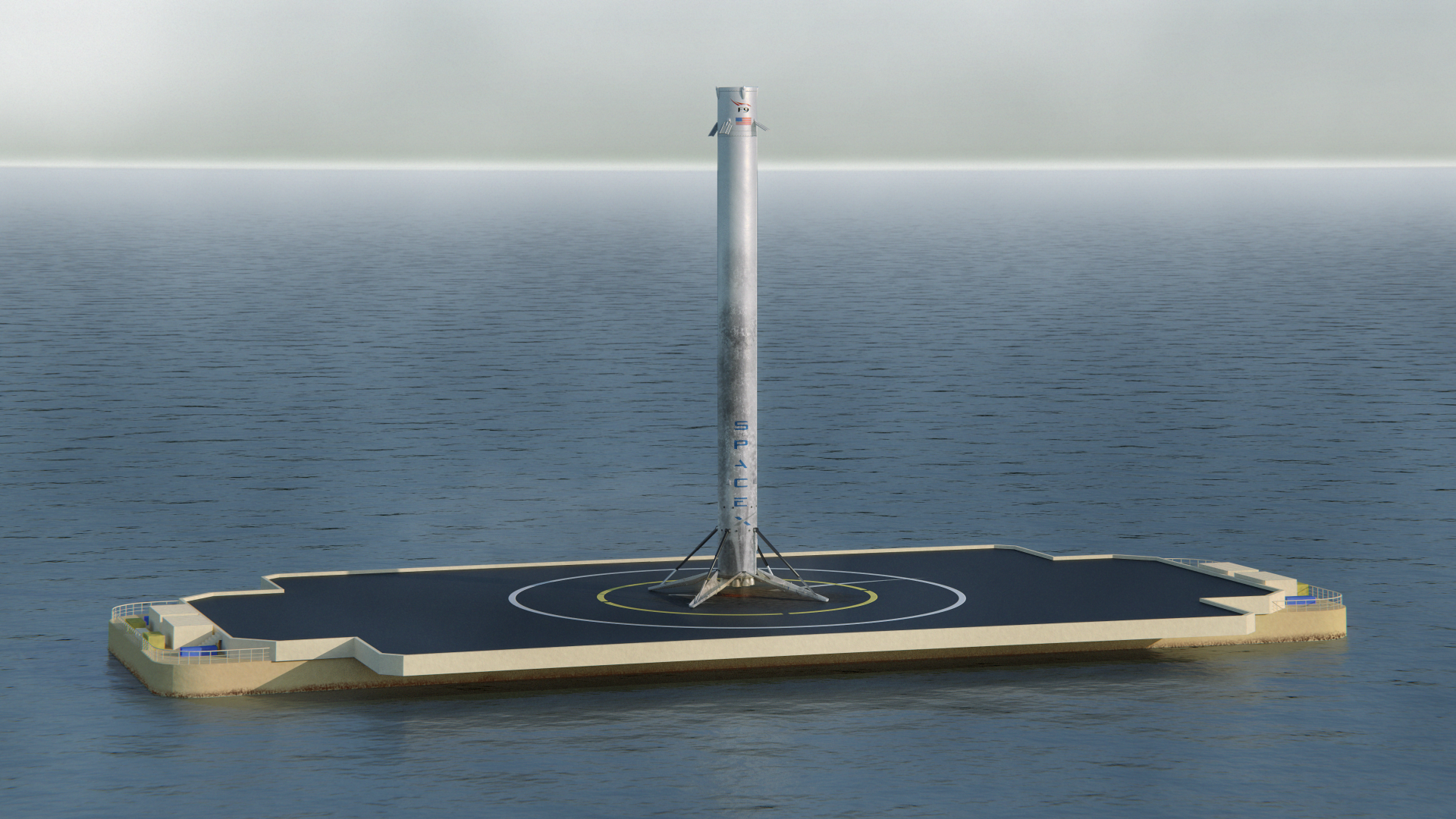
The company SPACEX is at the forefront of space travel and innovation.  This Sunday, February 8, at approximately 6:30 a.m. the company will be trying to push even further.  SPACEX will be for the second time trying to launch and land its Falcon 9 rocket.  This attempt was made earlier and can be seen failing here: https://vine.co/v/OjqeYWWpVWK .  The attempt failed but just barely.  The rocket landed on a 300 ft. by 100 ft. barge in the Atlantic Ocean which is an enormous achievement for human space travel.  The company is obviously hoping to do much better this attempt but if they fail, SPACEX has another 15 launches already planned for this year alone, including its Falcon Heavy the world's most powerful rocket by a factor of 2.  What is the big deal about landing a rocket and taking off with it again though?  The answer is that this process would significantly decrease the cost of going up into space.  We would be able to send many more missions into space and learn a lot more about a vast area we still know very little.


 SPACEX Home
spacex

Jon Ross at @zlsadesign and zlsa.github.io
         Artist's impression of SpaceX rocket landing.                    

Thursday, January 29, 2015

Sailing on the high Space?

We will as a civilization be sailing through space like we once sailed the oceans to find new lands? The Planetary Society hopes so.  This non-for profit group has been funded solely by citizens and is planning to send two missions into space in the coming months.  In May 2015 the company will be sending up its first test satellite in order to test the operational systems of their space sail or LightSail as they call it.  Then in 2016 the company will send the finalized rocket up out of Earth's orbit and find out if the idea of a space sail is effective. But how does a space sail work?  There is no wind in space so what can push it and the craft it's attached to forward? The answer, tiny light energy particles called protons.  When the protons hit the surface of the sail they transfer their momentum to the sail and cause it to accelerate forward.  These particles travel extremely fast, the speed of light, but have very little mass.  This gives them very little momentum but over a period of time the momentum would build as the space craft traveled causing an eventual acceleration that would get very fast.  This way of producing acceleration for a spacecraft would be very cost effective because it provides a limitless source of power to push the craft forward unlike chemical or gas rockets.
PHOTONS HAVE ENERGY AND MOMENTUM
THE PHOTONS REFLECT OFF THE SAIL, TRANSFERRING MOMENTUM

Friday, January 23, 2015

The Rocket That Will Power Orion

NASA's new rocket is constructed is about to begin testing.  The Space Launch System or SLS is designed specifically for Orion and to propel the ship to Mars and asteroids in the near future.  The new rocket is similar to the ones used on the space shuttle and employs some of the same technology. The boosters for the rocket will be used for the first two minutes of flight in order to get the ship out of the Earth's gravitational pull.  There are two boosters and each will provide a trust of 3.6 million pounds of thrust.  Once the boosters run out they will detach and the ship will be left with its cryogenic liquid hydrogen and liquid oxygen supplies that will feed the vehicle’s RS-25 engines. These engines will do all the work once in space and will be able to take man to, with the help of Orion, finally to the red planet.
The first qualification motor for NASA's Space Launch System's booster is installed in ATK's test stand in Utah.
The first qualification motor for NASA's Space Launch System's booster is installed in ATK's test stand in Utah and is ready for a March 11 static-fire test.
Image Credit: 
ATK

Thursday, January 15, 2015

The EmDrive, breaking Physics??


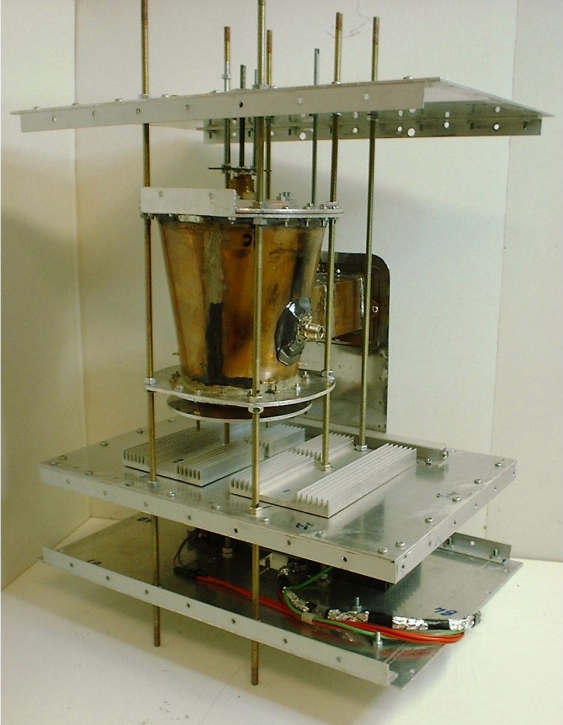
Two weeks ago I talked about the great possibilities of metallic hydrogen as a fuel source for deep space travel.  This week I looked into the idea of an EmDrive.  This device as seen to the left uses microwave technology with the input of DC power to propel objects forward without using a propellant like gas.  It uses a magnetron to push microwave waves through a tunnel slowing them down, and creating different levels of pressure in the cone of the device which causes the thrust.  This system of creating thrust in space has many advantages.  First it substantially reduces the weight for fuel on any spacecraft.  It also can run continuously for 15 years with only the help of a solar panel to supply its needed electrical input which also saves on the costs for sending a project into space. The EmDrive has also been tested and passed by NASA as having serious potential for the future.  The current thrust for this machine low but in space it doesn't take much force to get moving and being able to apply a force for a long time allows for a constant acceleration.The EmDrive is a very complex machine and if you would like to learn more about how it works, its potential for future exploration, and how it was created visit http://emdrive.com/

Monday, January 12, 2015

Cryosleep?

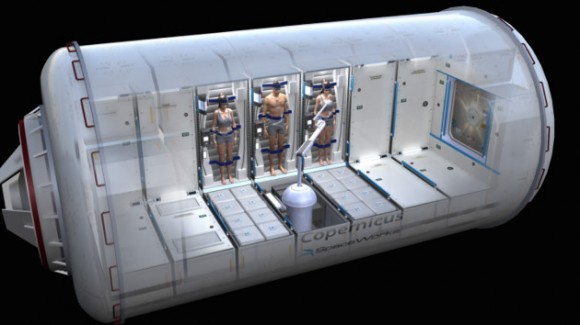
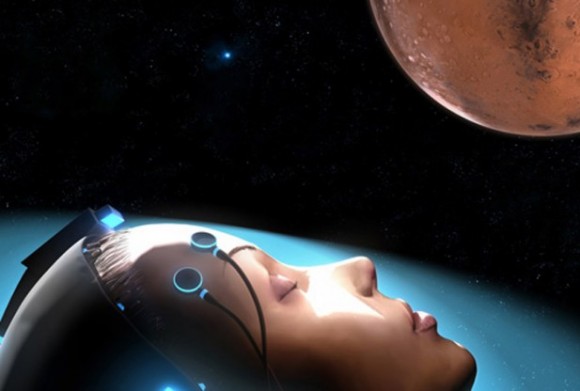
Some of the major issues with deep space travel lie with how to sustain human life.  Humans eat, sleep, exercise, work, and relax.  All of these facets of life require space and some form of energy.  These two factors cause the price of sending a person into space to literally skyrocket.  One way to get around all of these issues would be an extended human hibernation.  You may be thinking cryosleep that's only in science fiction movies, but recently NASA has been looking into a process much similar to it.  The process is called Torpor.  To put the astronauts to sleep their bodies are put into a low-metabolic state using therapeutic hibernation and total paternal nutrition.  These processes would keep a person's body asleep but also supply them with the nutrients they need.  The leading research partner to NASA in this process is called SpaceWorks and already the company is making huge plans.  As seen on their power point on Torpor, Torpor pdf , the company has already made preliminary designs for deep space travel using their system of hibernation.  With this system it would allow for a 180 day journey where the crew of the spaceship would be awake for just the beginning and end of the voyage. The continuation of research into this area may be one of the largest contributing factors to allow the human race to finally explore the universe.
Image Credit: SpaceWorks
Artist's concept of "sleeping to Mars". Photo Credit: SpaceWorks Enterprising
Artist’s concept of “sleeping to Mars”. Photo Credit: SpaceWorks Enterprising

                                                                 Artist’s concept for Mars-ready habitat. Image Credit: SpaceWorks

Thursday, December 18, 2014

The Fuel of the Future?

CARSTEN COSTARD
Mikhail Eremets (left) and Ivan Troyan stand by the 
apparatus they used to create what they believe to be 
metallic hydrogen

Is metallic hydrogen the key to future space travel? Many believe this is so.  The fuel is very lightweight, powerful, and is theorized to be found on Jupiter and Saturn.  Water is the fuel's only after use by-product and the fuel creates up to five times the efficiency of liquid H2/O2, the fuel that the Space Shuttle previously used.  The only draw back to this source of power is that it has not yet been officially created.  In 2011 the men shown above, believe they created the metallic form of hydrogen by pressing the gas form between two diamond tips until the pressure reached 270 billion pascals (270 G Pa), or about 2 million times Earth's atmospheric pressure at sea level.  This amount of force caused the gas to turn into a metal for a brief moment, but this is still highly questioned.  If this form of hydrogen can be created on Earth it would be a huge advance for deep space travel because it would allow for deep space refueling at the giant gas planets.       

Sunday, December 7, 2014

Finally Liftoff

Delta IV soars into space
The United Launch Alliance Delta IV Heavy rocket with NASA’s Orion spacecraft mounted atop, lifts off from Cape Canaveral Air Force Station's Space Launch Complex 37 at at 7:05 a.m. EST, Friday, Dec. 5, 2014, in Florida.
Image Credit: 
NASA/Bill Ingalls

Orion floats in the Pacific Ocean
The Orion crew module splashed down in the Pacific Ocean about 600 miles southwest of San Diego.
Image Credit: 
NASA TV

After much anticipation and a whole extra day of waiting Orion was finally launched into orbit around the Earth.  At 7:05 EST Friday December 5 Orion took off from Cape Canaveral Air Force Station on top of the United Launch Alliance Delta IV Heavy rocket.  The original launch date, December 4, was scrubbed after many difficulties with high winds, a boater, and a valve issue on the Delta IV Heavy Rocket.  The launch time was continuously pushed back until the two hour and thirty minute launch window starting at 7:05 was over.  Friday, however was a success all around.  Orion took off at the planned 7:05 and returned to Earth at 11:49.  The flight was seen as major success by all of the parties associated with the rocket and capsule.  The purpose of the mission was to test the separation systems, radiation shields, and return systems of the rocket.  By just watching the liftoff and return the separation and return systems worked like they were designed to.  The parachutes on the return of Orion slowed the module down from 20,000 mph to 20 mph before the rocket landed in the Pacific Ocean.  NASA is reporting good signs from the initial data they have received from the rocket so far for its radiation shields.  Overall this launch is another huge step for deep space exploration and for mankind.

Thursday, November 20, 2014

Days Before Launch


ULA engineers and technicians prepare to lift Orion atop the Delta IV Heavy rocket.
United Launch Alliance engineers and technicians prepare to lift the Orion spacecraft for stacking atop the Delta IV Heavy rocket Nov. 12 at Space Launch Complex 37 at Cape Canaveral Air Force Station in Florida.
Image Credit: 
NASA/Radislav Sinyak

On November 11th NASA's Orion spacecraft moved to its launch area at Space Launch Complex 37 at Cape Canaveral Air Force Station.  It took one day and reached this area on November 12th and has been preparing for its December 4th launch date since.  In order to get Orion into space it will be connected to the United Launch Alliance Delta IV Heavy rocket.  This rocket will take Orion 3600 miles above the surface of the Earth where the rocket will complete two full orbits of the Earth.  During these orbits the space module will travel through the high radiation zones of space in order to test its critical systems.  No humans will be on board this test flight, so every bit of information collected by the on-board computers will be important for future flights.  Orion will reenter Earth's atmosphere at 20,000 miles per hour and will land safely in the Pacific Ocean.  There the U.S. Navy will retrieve the spacecraft so that it can be reused.  The video below from NASA describes Orion's first flight in more detail.  

Thursday, November 6, 2014

From the Stars We Came, So to the Stars We Must Go...


As stated from some of the greatest minds of all time, this video shows the vastness we as humans are apart of and call home.  The ideas stated by Lawrence Krauss, Neil Degrasse Tyson, and Carl Sagan are the reason every person should strive for the stars.  They all pose the question of what humankind can achieve from the stars and the knowledge we can gain.  The Final Frontier Project hopes to make the dream of reaching out towards the planets and stars a reality.  The motivation for this project comes from these men and the idea that mankind and every organism on Earth is part of a much grander home than we currently know.  We are all apart of the infinite universe that is made from the same materials that make us.

Wednesday, October 1, 2014

Take Off.....

When we look at the universe, Earth and everything that calls it home are but a minute fraction of everything that lies beyond our gravitational field.  Beyond our planet are other planets making up our solar system.  Beyond our solar system are other solar systems which make up galaxies.  Beyond these galaxies are more galaxies making up galaxy groups.  Beyond these galaxy groups there are more galaxy groups which make up super galaxy groups.  Beyond this point science does not yet know.  My senior project is the idea that this vast amount of space that surrounds everyone of us must be explored and the only way to accomplish this task is by building an extended-time spaceship.  What are the features, requirements, and costs of a ship that can travel to where we can no longer see.  This final frontier project will answer these three questions and provide an answer on how to explore the enormous system that we as a whole make up only a fraction.